

-
1 initiële status
• initial condition mode• initial mode• reset mode -
2 исходное положение
исходное положение
Режим работы аналоговой или аналого-цифровой вычислительной системы, машины, устройства или их составных частей, характеризующийся исходным состоянием машинных переменных.
[ ГОСТ 18421-93]
Тематики
- аналоговая и аналого-цифровая выч.техн.
EN
FR
3.76 исходное положение (start position): Положение, указывающее на то, что система не находится в режиме блокировки, еще не получила сигнал запуска и не может перейти в цикл запуска.
Источник: ГОСТ Р 54110-2010: Водородные генераторы на основе технологий переработки топлива. Часть 1. Безопасность оригинал документа
Русско-английский словарь нормативно-технической терминологии > исходное положение
-
3 режим задания начальных условий
1) Engineering: initialization mode2) Information technology: initial condition mode (для аналоговой ЭВМ), reset mode (для аналоговой ЭВМ)3) General subject: resetУниверсальный русско-английский словарь > режим задания начальных условий
-
4 переключаться с ... на
•These versatile machines are easily changed over from one process to another.
•The integrator is switched from the initial-condition mode to the compute mode.
Русско-английский научно-технический словарь переводчика > переключаться с ... на
-
5 состояние
condition, mode вчт., state, status* * *состоя́ние с.
state, conditionв состоя́нии литья́ — (in the) as-cast (condition)в состоя́нии напла́вки — (in the) as-deposited (condition)возмуща́ть состоя́ние — ( малые возмущения) perturb a state; ( большие возмущения) disturb a stateв отожжё́нном состоя́нии — (in the) as-annealed (condition)в состоя́нии поста́вки — (in the) as-delivered (condition)в состоя́нии прока́тки — (in the) as-rolled (condition)в состоя́нии сва́рки — (in the) as-welded (condition)в состоя́нии термообрабо́тки — (in the) as-heat-treated (condition)переходи́ть из нача́льного в коне́чное состоя́ние ( в термодинамике) — change from the initial to the final stateпереходи́ть из одного́ состоя́ния в друго́е — pass from one state to anotherпо состоя́нию документа́ции на … — as per documents in effect on …амо́рфное состоя́ние — amorphous stateсостоя́ние балансиро́вки ав. — trimвыводи́ть (самолё́т) из состоя́ния балансиро́вки — trim out (an airplane)состоя́ние бе́дствия — the distress statusотменя́ть состоя́ние бе́дствия — cancel the distress statusбезразли́чное состоя́ние (цифрового мата, релейной цепи и т. п.) вчт. — don't care condition, don't care stateвака́нтное состоя́ние — unoccupied [vacant] stateвале́нтное состоя́ние — valent stateсостоя́ние вещества́, агрега́тное — state of aggregation of matterвзве́шенное состоя́ние — suspensionнаходи́ться во взве́шенном состоя́нии — be suspended, be in suspensionсостоя́ние «включено́» — “on” stateвозбуждё́нное состоя́ние — excited stateсостоя́ние «вы́ключено» — “off” stateвы́мороженное состоя́ние — frozen stateвы́рожденное состоя́ние полупр. — degenerated stateгазообра́зное состоя́ние — gaseous stateсостоя́ние гото́вности — ready status, ready stateдетермини́рованное состоя́ние киб. — determinate stateдиспе́рсное состоя́ние — disperse stateсостоя́ние «едини́ца» вчт. — one [“1”, unity] stateжи́дкое состоя́ние — liquid stateсостоя́ние заря́да ( уровень заряжённости аккумулятора или батареи) — state of chargeиско́мое состоя́ние киб. — target stateква́нтовое состоя́ние — quantum stateконе́чное состоя́ние — final stateкристалли́ческое состоя́ние — crystalline stateкрити́ческое состоя́ние — critical state, criticalityлате́нтное состоя́ние — latent state, latency, abeyanceнагарто́ванное состоя́ние — cold-worked conditionсостоя́ние нажо́ра кож. — plumping, plumpnessсостоя́ние наклё́па — cold-worked conditionнапряжё́нное состоя́ние — stressed state, state of stressнача́льное состоя́ние — initial stateсостоя́ние невесо́мости — state of weightlessness, gravity-free [weightless, zero-gravity, zero-g] stateневы́рожденное состоя́ние полупр. — non-degenerate stateнедосту́пное состоя́ние — inaccessible stateненапряжё́нное состоя́ние — limp stateнеобрати́мое состоя́ние — irreversible stateнепроводя́щее состоя́ние — non-conducting stateнеравнове́сное состоя́ние — non-equilibrium stateнеупоря́доченное состоя́ние — disordered stateнеустанови́вшееся состоя́ние — unsteady stateнеусто́йчивое состоя́ние — unstable [labile] state«нуль» состоя́ние вчт. — zero [“0”] stateобрати́мое состоя́ние — reversible stateсостоя́ние ожида́ния вчт. — wait stateпереходи́ть в состоя́ние ожида́ния — go into a wait stateсостоя́ние оста́точной намагни́ченности — remanent stateсостоя́ние отсе́чки — cut-off stateпарообра́зное состоя́ние — vaporous stateперенасы́щенное состоя́ние — supersaturated stateпереохлаждё́нное состоя́ние — supercooled stateсостоя́ние поко́я — rest(быть) в состоя́нии поко́я — (be) at rest, quiescent stateпреде́льное состоя́ние1. limiting state2. т. над. final conditionпромежу́точное состоя́ние — intermediate stateрабо́чее состоя́ние — running [working] order, serviceable conditionподде́рживать в рабо́чем состоя́нии — maintain (the plant) in a satisfactory state of operator [in proper working order]равнове́сное состоя́ние — equilibrium state, state of equilibriumраспла́вленное состоя́ние — molten stateсверхпроводя́щее состоя́ние — superconducting stateсвобо́дное состоя́ние — free stateсостоя́ние с высо́ким потенциа́лом вчт. — high levelустана́вливать в состоя́ние высо́кого потенциа́ла — bring to high levelустана́вливаться в состоя́ние высо́кого потенциа́ла — go highсостоя́ние с высо́кой добро́тностью — high-Q stateсвя́занное состоя́ние — bound stateсостоя́ние с ни́зким потенциа́лом вчт. — low levelустана́вливать в состоя́ние ни́зкого потенциа́ла — bring to low levelустана́вливаться в состоя́ние ни́зкого потенциа́ла — go lowсо́бственное состоя́ние — eigenstateтвё́рдое состоя́ние — solid stateупоря́доченное состоя́ние — ordered stateустанови́вшееся состоя́ние — steady stateусто́йчивое состоя́ние — stable stateуточнё́нное состоя́ние вчт. — senseсостоя́ние элеме́нта па́мяти — state of a storage elementопра́шивать состоя́ние [производи́ть опро́с состоя́ния] элеме́нта па́мяти — interrogate [sense the state of] a storage elementраспознава́ть состоя́ние элеме́нта па́мяти — sense the state of a storage elementэнергети́ческое состоя́ние — energy stateэнергети́ческое, незапо́лненное состоя́ние — unfilled [unoccupied, vacant] (energy) stateэнергети́ческое, основно́е состоя́ние — ground (energy) stateэнергети́ческое, разрешё́нное состоя́ние — allowed (energy) state -
6 режим
mode, condition, regime,
function, operation, rating, setting
- (вид работы аппаратуры, системы) — mode
- (заданные условия работы двигателя при определенном положении рычага управнения двигателем) — power setting. in changing the power setting, the power-control lever must be moved in the manner prescribed.
- (мощность или тяга двигателя в сочетании с определениями как взлетный, крейсерский максимально-продолжитепьный) — power, thrust. takeoff power /thrust/. maximum continuous power /thrust/
- (номинальный, паспортный, расчетный) — rating
работа в заданном пределе рабочих характеристик в определенных условиях. — rating is а designated limit of operating characteristics based оп definite conditions.
- (номинальная мощность или тяга двигателя, приведенная к стандартным атмосферным условиям) — power rating. power ratings are based upon standard atmospheric conditions.
- (при нанесении покрытия) — condition
- (работы агрегата по производительности) — rating. pump may be operated at low or high ratings.
- (тяги двигателя при апрелеленном положении руд) — thrust. run the engine at the takeoff thrust.
- (частота действий) — rate
- автоматического захода на посадку — automatic approach (eondition)
- автоматического обмена данными с взаимодействующими системами (напр., ins, tacan) — (mode of) transmission and/or reception of specifled data between systems in installations such as dual ons, ins, tacan, etc.
- автоматического управления полетом — automatic flight condition
- автоматической выставки (инерциальной системы) — self-alignment mode
- автоматической работы двигателя. — engine governed speed condition
at any steady running condition below governed speed.
- автоматической (бортовой) системы управления (абсу, сау) — afcs (automatic flight control system) mode
- автомодуляции — self-modulation condition
-, автономный (системы) — autonomus /independent/ mode
-, автономный (системы сау) — independent control mode
- авторотации (вертолета) — autorotation, autorotative condition
заход на посадку производится с выключенным двигателем на режиме авторотации несущего винта. — the approach and landing made with power off and entered from steady autorotation.
- авторотации (воздушного винта, ротора гтд, вращающегося под воздействием набегающего воздушного потока) — windmilling. propeller ог engine rotor(s) freely rotating because of а wind or airstream passing over the blades.
-, астроинерциальный — stellar inertial mode
- астрокоррекции — stellar monitoring mode
-, бесфорсажный (без включения форсажной камеры) — cold power /thrust/, попafterburning power /thrust/
-, бесфорсажный (без впрыска воды или воднометаноловой смеси на вход двигателя) — dry power, dry thrust
- бов (блока опасной высоты) — alert altitude (select) mode
-, боевой (работы двигателя) — combat /military/ rating, combat /military/ power setting
- бокового управления (системы сту) — lateral mode. the lateral modes of fd system are: heading, vor/loc, and approach.
- большой тяги (двиг.) — high power setting
- буферного подзаряда аккумулятора — battery trickle charge (condition)
- быстрого согласования (гиpoагрегата) — fast slave mode
- ввода данных — data entry mode
- вертикальной скорости (автопилота) — vertical speed (vs) mode
-, вертикальный (системы сду или сту) — vertical mode. the basic vertical modes are mach, ias, vs. altitude, pitch
-, взлетный (двигателя) — takeoff power
-, взлетный (тяга двиг.) — takeoff thrust
-, взлетный (полета) — takeoff condition
- висения (вертолета) — hovering
- "вк" (работы базовой системы курса и вертикали (бскв) при коррекции от цвм) — cmptr mode
-, внешний (работы сау) — coupled /interface/ control mode
-, возможный в эксплуатации) — condition (reasonably) expected in operation
- вор-илс (работы директорией системы) — vor-loc mode, v/l mode
- воспроизведения (магн. записи) — playback mode
- выдерживания (высоты, скорости) — (altitude, speed) hold mode
- выдерживания заданного курса — hog hold mode
- "выставка" (инерциальной системы) — alignment /align/ mode
в режиме "выставка" система автоматически согласуется e заданными навигационными координатами и производится выставка гироскопических приборов, — in align mode system automatically aligned with reference to navigation coordinates and inertial instruments are automatically calibrated.
- выставки, автоматический (инерциальной навигационной системы) — self-alignment mode. the align status can be observed any time the system is in self-alignment mode.
- вычисления параметров ветpa — wind calculator mode. wind calculator mode is based on manually entered values of tas
- вызова (навигационных параметров на индикаторы) — call mode
- вызова на индикаторы навигационных параметров без нарушения нормального самолетовождения (сист. омега) — remote mode. position "r" enables transmission and/or reception of specified data between systems in installations such as dual ons, ins/ons, etc.
-, генераторный (стартер-генератора) — generator mode
стартер-генератор может работать в генераторном или стартерном режиме, — starter-generator can operate in generator mode or in motor mode (motorizing functi on).
-, гиперболический (работы системы омега) — hyperbolic mode. in the primary hyperbolic mode the position supplied at initialization needs only to be accurate to within 4 nm.
- гиромагнитного (индукционного) компаса (гmk) — gyro-flux gate (compass) mode
- гиромагнитной коррекции (гмк) — magnetic slaved mode (mag)
- гmк (гиромагнитного компаca) — gyro-flux gate (compass) mode
- горизонтального полета — level flight condition
- горячего резерва (рлс) — standby (stby) mode
- гпк (гирополукомпаса) — dg (directional gyro) mode, free gyro mode of operation
- "да-нет" (работы, напр., сигнальной лампы) — "yes-no" operation mode
-, дальномерный (дме) — dме mode
-, дальномерный (счисления пути) (системы омега) — dead reckoning mode, dr mode of operation, relative mode
- двигателя (no мощности или тяге) — engine power /thrust/, power /thrust/ setting
- (работы двигателя) для захода на посадку — approach power setting
-, дежурный (работы оборудования) — standby rate (stby rate)
- завышенных оборотов — overspeed condition
- заниженных оборотов — underspeed condition
- заданного курса (зк) — heading mode
режим работы пилотажного командного прибора (пкп) дпя выхода на и выдерживания зк. — in the heading mode, the command bars in the flight director indicator display bank (roll) commands to turn the aircraft to and maintain this selected heading.
- заданного путевого угла (зпу) — course mode
- захвата луча глиссадного (курсового) радиомаяка — glideslope (or localizer) cарture mode
- "земля-контур" (рлс) — contour-mapping mode
- земного малого газа — ground idle power (setting)
with engines operating at ground idle (power).
- и/или тяга, максимальный продолжительный — maximum continuous power and/or thrust
-, импульсный (сигн. ламп) — light flashing
"откл. имп. режима" (надпись) — lt flash cutout
- инерциально-доплеровский (ид) — inertial-doppler mode
-, инерциальный (работы навигационной системы) — inertial mode
-, командный (автопилота) — (autopilot) command position
both autopilots in command position.
-, компасный — compass mode
в компасном режиме магнитная коррекция курса обеспечивается датчиком ид. — when compass mode is selected, magnetic monitoring is applied from detector unit.
-, компасный (apk) (автоматического радиокомпаса) — adf compass mode. the adf function switch is set to "comp" position, (to operate in the compass mode).
- "контроль" (инерц. системы) — test mode
обеспечивает автономную проверку системы без подкпючения контр.-повер. аппаратуры. — provides the system selftesting
- (-) "контур" -(работы рлс) — contour (mode) (cntr)
- коррекции (координат места) — up-dating mode
-, крейсерский (двиг.) — cruising /cruise/ power
-, крейсерский (на з-х двигатолях) (полета) — 3-engine cruise
-, крейсерский (полета) — cruising (condition)
-, крейсерский (с поэтапным увеличением оборотов при испытании двигателя) — incremental cruise power (or thrust)
-, крейсерский, номинальный (полета) — normal cruise (nc)
-, крейсерский рекомендуемый (максимальный) — (maximum) recommended cruising power
- крейсерского полета (для скоростной или максимальной дальности) — cruise method
-, критический (работы системы, двигателя) — critical condition
- критический, по углу атаки — stalling condition
- "курсовертикаль" ("kb") — attitude (атт) mode
в данном режиме от системы не требуется получение навигационных параметров. выдаются только сигналы крена (у) и тангажа (у). — in this mode ins alignment and navigation data, except attitude, are lost.
-, курса-воздушный — air data-monitored heading hoid mode
-, курсовой (при посадке по системе сп или илс) — localizer mode
- курсозадатчика (курсовой системы гмк или гик) — flux gate slaving mode. the mode when the directional gyro is slaved to the flux gate detector.
-, курсо-доплеровский — doppler-monitored heading hold mode
- магнитной коррекции (мк) — magnetic(ally) slaved mode (mag)
- максимальной (наибольшей) дальности — long range cruise (lrc). lrc is based on a speed giving 99 % of max, range in no wind and 100 % max. range in about 100 kt headwind.
- максимальной продолжительности (полета) — high-endurance cruise
-, максимальный крейсерский (mkp) (выполняется на предельной скорости) — high speed cruise (method)
-, максимальный продолжительный (мпр) (двиг.) — maximum continuous power (мcp)
-, максимальный продолжительный (по тяге) — maximum continuous thrust (мст)
increase thrust to мст.
- малого газа — idling power (setting)
попеременная работа двигателя на номинальной мощности и режиме малого газа или тяги, — one hour of alternate fiveminute periods at rated takeoff power and thrust аnd at idling power and thrust.
- малого газа на земле — ground idling power /conditions/
- малого газа при заходе на посадку — approach idling power /conditions/
- малой тяги (двиг.) — low power setting
- (-) "метео" (работы рлс) — weather (mode)
- "метео-контур" (рлс) режим — contour-weather mode
- (5-ти) минутной мощности (двиг.) — (five-) minute power
- "мк" (магнитной коррекции) — mag
- мощности, максимальный продолжительный (двиг.) — maximum continuous power
- мощности, чрезвычайный — emergency power
- набора высоты — climb condition
- "навигация" (инерциальной системы) — navigation (nav) mode
при заданном режиме система обеспечивает вычисление навигационных и директорных параметров и выдает информацию на пилотажные приборы и сау. — in this mode system computes navigation and steering data. provides attitude information to flight instruments and fcs.
- наибольшей (макеимальной) дальности — long range cruise (lrc)
горизонтальный полет на скорости наибольшей дальности, на которой километровый расход топлива при полете на заданной высоте наименьший. — а level flight at а given altitude and best range cruise speed giving the minimum kilometric fuel consumption.
- наибольшей продолжительности (полета) — high-endurance cruise
горизонтальный полет на скорости наибольшей продолжнтельности, на которой часовой расход топлива при полете на заданной высоте наименьший. — а level flight at а given altitude and high-endurance cruise speed giving the minimum fuel flow rate (in kg/h or liter/h)
- начала автоматической работы (нар режим начала автоматического регулирования работы гтд) — engine governed run/operation/ onset mode
- нвк (начальной выставки — initial heading alignment
-, непрерывной (обработки данных) — burst mods (data processing)
-, нерасчетный — off-design rating
-, неуетановившийся — unsteady condition
- (0.65) номинала, на бедной смеси — (65%) power, lean mixture setting
-, номинальный (двиг.) — (power) rating, rated power
-, номинальный (mпp) — maximum continuous power
- нормального обогрева (эп.) — normal-power heat (condition)
-, нормальный (работы агрегата) — normal rating
-, номинальный крейсерский (полета) — normal cruise (nc). used on regular legs and based on m = 0.85.
- обзора земной поверхности (рлс) — ground-mapping (map) mode
- обнаружения грозовых образеваний — thunderstorm detection mode (wx)
- "обогрев" (инерц. системы) — standby mode
режим предназначен для создания необходимых температурных условий работы элементов инерциальной системы (гироскопов, блоков автоматики и электроники). — the standby mode is а heating mode during which fast warm-up power is applied to the navigation unit until it reaches operating temperature.
- обогрева — heating mode
- обогрева лобовых стекол "слабо", "сильно" — windshield "warm up", "full power" heating rating
-, одночасовой максимальный (двиг.) — maximum one-hour power
- ожидания ввода координат исходного места самолета — initial position entry hold mode
- ожидания посадки — holding
-, оптимальный экономический (двиг.) — best economy cruising power
- освещения меньше-больше (яркость) — dim-brt light modes check lights in dim and brt modes.
-, основной навигационный (сист. "омега") — primary navigation mode
- отключенного шага (программы) — step off mode
- отсутствия сигналов ивс (системы омега) — no tas mode
- оценки дрейфа гироскопа — gyro drift evaluation mode
- перемотки (маги, ленты) — (tape) (re)wind mode
- пересиливания автопилота — autopilot overpower operation /mode/
-, переходный — transient condition
- планирования — gliding condition
- повышенных оборотов — overspeed condition
- полета — flight condition /regime/
состояние движения ла, при котором параметры, характеризующие это движение (например, скорость, высота) остаются неизменными в течение определенного времени. — it must be possible to make а smooth transition from one flight condition to any other without exceptional piloting skill, alertness, or strength.
- полета, критический — critical flight (operating) condition
- полета на курсовой маяк (при посадке) — localizer (loc) mode. flying in loc (or vor) mode.
- полета на станцию вор — vor mode
- полета, неустановившийся — unsteady flight condition
- полета по маяку вор — vor mode
- полета по системе илс — ils mode
- полета по условным меридианам — grid mode
данный режим применяется в районах, не обеспечивающих надежность компасной информации. — the grid mode can be used in areas where compass information is unreliable.
- полета, установившийся — steady flight condition
- полетного малого газа — flight idle (power)
-, полетный (двиг.) — flight power
-, пониженный (ниже номинала) (двиг.) — derating
- пониженных оборотов — underspeed condition
при возникновении режима пониженных оборотов рогулятор оборотов вызывает дополнительное открытие дроссельного крана. — for underspeed condition, the governor will cause the larger throttle opening.
-, поперечный (системы сду или сту) — lateral mode. the basic lateral modes are heading, vor/loc and approach.
-, посадочный (полета) — landing condition
- правой (левой) коррекции (оборотов двигателя вертолета) — engine operation with throttle control twist grip turned clockwise (counterclockwise)
-, практически различаемый — practically separable operating condition
к практически различаемым режимам полета относятся: взлетный, крейсерский (mapшрутный) и посадочный, — practically separable operating condition, such as takeoff, en route operation and landing.
- (работы двигателя), приведенный к стандартной атмосфере — power rating based upon standard atmospheric conditions
- приведения к горизонту — levelling
- продления глиссады — glideslope extension mode
the annunciator indicates when glideslope extension (ext) mode provides command signals to the steering computer.
- продольного управления (системы сту) — vertical mode. the vertical modes of fd system are: mach, ias, vs. altitude, pitch.
- просмотра воздушного пространства (переднего) — airspace observation mode (ahead of aircraft)
- просмотра воздушного пространства на метеообстановку (рлс) — radar weather observation mode
- просмотра земной поверхности (рлс) — ground mapping operation. the antenna is tilted downward to receive ground return signals.
- прямолинейного горизонтального полета — straight and level flight condition
- (частота) пусков ракет — (rocket firing) rate
- "работа" (положение рычага останова двигателя) — run
- "работа" (инерциальной навигационной системы) — navigate mode, nav mode. system automatically changes from alignment to navigate mode.
- работы — condition of operation
test unit in particular condition of operation.
- работы (агрегата, напр., наcoca) — rating
- работы (агрегата по продолжительности) — duty (cycle)
режим работы может быть продопжитепьным или повторно-кратковременным. — the duty cycle may be continuous or intermittent.
- работы (инерциальной системы) — mode of operation, operation mode
- работы, автоматический (двиг.) — governed speed /power/ setting
- работы автоматической системы управления (абсу, сау) — autoflight control system (afcs) mode
- работы автопилота — autopilot mode
- работы автопилота в условиях турбулентности — autopilot turbulence (turb) mode
при работе в условиях турбулентности включается демпфер рыскания для обеспечения надежной управляемости и снижения нагрузок на конструкцию ла. — use of the yaw damper with the autopilot "turb" mode will aid in maintaining stable control and in reducing structural loads.
- работы автопилота при входе в турбулентные слои атмосферы — autopilot turbulence penetration mode
данный режим применяется при полете в условиях сильной турбулентности воздуха, — use of the autopilot turbulence penetration mode is recommended for autopilot operation in severe turbulence.
- работы автопилота с директорной системой, совмещенный — ap/fd coupled mode
- работы двигателя (по мощности) — engine power (setting)
- работы двигателя (по тяге) — engine thrust (setting)
- работы двигателя (по положению руд) — engine power setting
- работы двигателя в особых условиях, (повышенный) — emergency (condition) power
- работы двигателя на земле — engine ground operation
- работы двигателя на малых оборотах — engine low speed operation
- работы двигателя, номинальный — engine rating. ths jt9d-з-за engines operate at jt9d-3 engine ratings.
- работы (двигателя), приведенный к стандартной атмосфере — power rating /setting/ based upon standard atmospheric conditions
- работы источника света, установившийся — light source operation at steady value
- работы, кратковременный — momentary operating condition
- работы no времени (агрегата) — time rating
- работы, повторно-кратковременный (агрегата) — intermittent duty
пусковая катушка работает в повторно-кратковременном режиме. — booster coil duty is intermittent.
- работы (системы), полетный — (system) flight operation
при выпуске передней опоры шасси система переключается на полетный режим, — when the nose lg is eхtended, the function of the system is transferred to flight operation.
- работы no сигналам станции омега — omega mode operation
- работы, продолжительный (агрегата) — continuous duty
генератор двигателя работает в продолжительном режиме, — the engine-driven generator duty is continuous.
- работы противообледенительной системы, нормальный — normal anti-icing
- работы противообледенительной системы, форсированный — high anti-icing
- работы самолетного ответчика (а - на внутренних линиях, в - на международных) — transponder mode (а - domestic, в - international)
- работы системы траекторного управления (сту), боковой — lateral mode
- работы сту, продольный — vertical mode
- рабочий (работы автопилота) — (autopilot) active position both autopilots in command positions, one active and one standby.
- рабочий (работы оборудования) — normal rate (norm rate)
- равновесной частоты (вращения) (двиг.) — on-speed condition
- равновесных оборотов — оп-speed condition
работа регулятора оборотов в режиме равновесных оборотов. — the constant speed governor operation under on-speed condition.
-, радиотелеграфный, тлг (автоматич. радиокомпаса) — c-w operation
-, радиотелеграфный (связи) — c-w communication, radio telegraphic communication
-, радиотелефонный, тлф (apk) — rt (radio telephone), voice operation (v), voice
-, радиотелефонный (связи) — voice communication, radio telephone communication
переключить передатчик на радиотелефонную связь, — set the transmitter for voice communication.
-, рамочный (арк) — loop mode
- распознавания светила — star identification mode
-, располагаемый максимальный продолжительный (двиг.) — available maximum continuous power
-, расчетный — rating
-, расчетный (условия работы) — design condition
- регулирования избыточного давления (системы скв) — differential pressure control (mode)
-, резервный (аварийный) (дв.) — emergency power rating
работа двигателя при гидромеханическом управлении оборотами и температурой при отказе электронной системы управления.
-, резервный (работы автопилота) — (autopilot) standby position
- самовращения (несущего винта) — autorotation, autorotative condition
- самоориентирования (переднего колеса шасси) — castoring
- скоростной дальности — high-speed cruise method
- "слабо", "сильно" (обогрева лобовых стекол) — (windshield heat) warm up, full power
- слабого обогрева (эл.) — warm-up heat (condition)
-, следящий (закрылков) — (flap) follow-up operation (mode)
when the flaps are raised, the flap follow-up system operates the slat control valve.
-, смешанный (работы спойлеров) — drag/aileron mode. а drag/aileron mode is used during descent both for retardation and lateral control.
- снижения — descent condition
-, совмещенного управления — override control mode
оперативное вмешательство в работу включенной системы.
-, совмещенный (при работе с др. системой) — coupled mode
-, совмещенной (работы автопилота) — autopilot override operation /mode/
в этом режиме отключаются рм и корректор высоты и летчик оперативно вмешивается в управление ла посредством штурвала и педалей. — то manually or otherwise deliberately overrule autopilot system and thereby render it ineffective.
-, совмещенный — both mode
(работы рлс в режимах обзора метеообразований и земной поверхности и индицирования маяков) — for operation in rad and bcn modes.
- согласования (автопилота) — synchronization mode
- согласования (работы следящей системы) — slave /synchronization/ mode
- стабилизации (крена, тайгажа, направления, автопилота) — roll (pitch, yaw) stabilization mode
- стабилизации (работы сту) — hold mode
the vertical and lateral modes are hold modes.
- стабилизации крена (в сту) — roll /bank/ (attitude) hold mode
- стабилизации курса (aп) — heading hold mode
- стабилизации тангажа (в сту) — pitch (attitude) hold mode
-, стартерный (всу) — engine start mode
apu may run in the engine start mode or as apu.
-, стартерный (стартер-гоноратора) — motor(izing) mode, (with) starter-generator operating as starter
- стопорения (работы следящей системы) — lock-out mode
- "сход(на) нзад" — return-to-selected altitude (mode)
- счисления пути (или дальномерный) (системы омега) — dead reckoning mode, dr mode of operation, relative mode
-, температурный — temperature condition
- тлг (работы арк) — c-w operation
- тлф (арк) — rt (radio telephone), voice
-, тормозной (работы спойле — drag /retardation/ mode
- управления — control mode
- управления в вертикальной плоскости (ап) — vertical mode
- управления в горизонтальной плоскости (инерциальной системы) — lateral control mode
управление по курсу, на маяки вор и крм. — the basic lateral modes are heading, vor/loc and approach.
- управления, позиционный (no командно-пилотажному прибору) — flight director control mode
- управления по крену (aп) — roll (control) mode
- управления, поперечный (автопилота) — lateral mode
- управления по тангажу (ап) — pitch (control) mode
- управления, продольный (автопилота) — vertical mode. vertical command control provides either vertical speed or pitch command.
- управления, штурвальный — manual (flight) control
-, усиленный (дополнительный, форсированный) (двиг.) — augmented power (rating)
при данном режиме увеличиваются температура газов на входе в турбину, обороты ротора или мощность на валу. — engine augmented takeoff power rating involves increase in turbine inlet temperature, rotor speed, or shaft power.
-, установленный (для данных условий испытаний двигателя) — rated power. а 30-hour run consisting of alternate periods of 5 minutes at rated takeoff power.
-, форсажный (с включенной форсажной камерой) — reheat /afterburning/ power /thrust/
-, форсажный (по тяге двиг.) — reheat thrust
-, форсажный (с впрыском воды или водометаноловой смеси на вход двигателя) — wet power, wet thrust
-, форсажный, полный (двиг.) — full reheat power /thrust/
- форсированного обогрева — full-power heat (conditions)
-, форсированный (работы агрегата) — high rating
-, форсированный (усиленный) (двиг.) — augmented power /thrust/
-, форсированный взлетный — augmented takeoff power
- холостого хода (двигателя вертолета с отключенной трансмиссией) — idle run power (with rotor drive system declutched)
- холостого хода (генератора, всу, электродвигателя) — по-load operation
-, чрезвычайный (работы двигателя в особых условиях) — emergency (condition) power
-, чрезвычайный (по тяге двигателя) — emergency thrust
-, чрезвычайный, боевой (двиг.) — combat /war/ emergency power
-, штурвальный (управления ла) — manual control mode
-, экономичный крейсерский — (best) economy cruising power
-, эксплуатационный (работы, агрегата, двигателя, самолета) — operational /operating/ condition
-, эксплуатационный (двиг.) — operational power rating
эксплуатационные режимы включают: взлетный, максимальный продолжительный (крейсерский), — operational power ratings cover takeoff, maximum continuous (and cruising) power ratings.
-, эксплуатационный полетный (двиг.) — flight power (rating)
двигатель должен нормально работать на всех эксплуатационных (полетных) режимах, — the engine must be capable of operation throughout the flight power range.
-, электромоторный (стартер генератора) — motor(izing) mode
-, элеронный (работы спойлеров) — aileron mode, lateral control augmentation mode
в p. (работы оборудования) — in mode
presently flying in heading (h) mode on a 030° heading.
в p. самоориентирования (о переднем колесе шасси) — in castor, when castoring
в пределах эксплуатационных р. — within (approved) operating limitations
выход на р. малого газа (двиг.) — engine (power) setting at idle, engine idle power setting
изменение p. работы двигатепя — change in engine power (or thrust)
метод установки (получения) (заданного p. работы двигателя) — methods for setting (engine) thrust /power/
на (взлетном) р. (двиг.) — at (takeoff) power
with the engine operating at takeoff power.
на (взлетном) р. (полета) — under (takeoff) condition
на максимальном продолжительном p. — at maximum continuous power
обороты (двигателя) на взлетном р. — takeoff (rotational) speed engine run at takeoff power with takeoff speed.
обороты (двигателя) на максимальном продолжительном p. — maximum continuous speed engine run at rated maximum continuous power with maximum continuous speed.
переключение p. (работы оборудования) — mode selection
переход (вертолета) от нормального р. к р. висения — reconversion
полет на крейсерском р. — cruise flight
полет на р. висения — hovering flight
при работе двигателя на взлетном р. — with engine at takeoff power, with takeoff power on (each) engine
при работе каждого двигателя на р., не превышающем взлетный — with not more than takeoff power on each engine
при установившемся р. работы с полной нагрузкой — at steady full-load condition
(75)% максимального продолжительного (или номинального) р. — (75) percent maximum continuous power (thrust)
работа на (взлетном) р. (двиг.) — (takeoff) power operation, operation at takeoff power
установка p. работы (двиг.) — power setting
этап p. (при испытаниях двигателя) — period. during the third and sixth takeoff power periods.
включать р. (работы аппаратуры системы) — select mode
включать р. продольного (поперечного) управления (aп, сду) — select vertical (lateral) mode
включить систему в режим (напр., "выставка") — switch the system to (align mode, switch the system to operate in (align mode)
выдерживать (взлетный) р. (двиг.) — maintain (takeoff) power
выходить на (взлетный) р. (двиг.) — come to /attain, gain/ (takeoff) power /thrust/, set engine at takeoff power /thrust/, throttle to takeoff power /thrust/
выходить на р. прямолинейного горизонтального полета гонять двигатель на (взлетном) р. — recover to straight and level flight run the engine at (takeoff) power
изменять р. работы двигателя — change engine power
изменять установленный р. (двиг.) — change power setting
лететь в автоматическом р. управления — fly automatically
лететь в курсовом р. — fly heading (н) mode
лететь в штурвальном р. — fly manually
передавать в телеграфном р. — transmit on c-w /rt/
передавать в радиотелефонном р. — transmit on voice
переключать р. — select mode
переключаться на р. — switch to mode the computer automatically switches to course mode.
переходить (автоматически) в режим (напр., курсовертикаль) — system automatically changes to атт mode
переходить с р. (малого газа) на (взлетный) р. (двиг.) — come from (idle) power to (takeoff) power
проводить р. (30 часовых) испытаний последовательно чередующимися периодами по... часов — conduct а (30-hour) run consisting of alternate periods of... hours
работать в р. — operate on /in/ mode
работать в режиме гпк — operate in dg mode, be servoed to directional gyro
работать в индикаторном р. (о сельсине) — operate as synchro indicator
работать в трансформаторном р. (о сельсине) — operate as synchro transformer
работать на (взлетном) р. (двиг.) — operate at (takeoff) power /thrust/
работать на р. малого газа — idle, operate at idle (power)
увеличивать р. работы (двиг.) (до крейсерского) — add power (to cruising), throttle (to cruising power)
уменьшать p. двигателя (до крейсерского) — reduce power to cruising
устанавливать взлетный р. (двиг.) — set takeoff power /thrust/, set engine at takeoff power
устанавливать компасный р. работы (apk) — select compass mode
устанавливать p. набора высоты — establish climb
устанавливать р. полета — establish flight condition
устанавливать рамочный р. работы (арк) — select loop mode
устанавливать (взлетный) р. работы двигателя — set (taksoff) power /thrust/, set the engine at takeoff power /thrust/
устанавливать p. снижения — establish descentРусско-английский сборник авиационно-технических терминов > режим
-
7 AT
I) prep.A. with dative.I. Of motion;1) towards, against;Otkell laut at Skamkatli, bowed down to S.;hann sneri egginni at Ásgrími, turned the edge against A.;2) close atup to;Brynjólfr gengr alit at honum, quite up to him;þeir kómust aldri at honum, they could never get near him, to close quarters with him;3) to, at;koma at landi, to come to land;ganga at dómi, to go into court;ganga at stræti, to walk along the street;dreki er niðr fór at ánni (went down the river) fyrir strauminum;refr dró hörpu at ísi, on the ice;5) denoting hostility;renna (sœkja) at e-m, to rush at, assault;gerði þá at þeim þoku mikla, they were overtaken by a thick fog;6) around;vefja motri at höfði sér, to wrap a veil round one’s head;bera grjót at e-m, to heap stones upon the body;7) denoting business, engagement;ríða at hrossum, at sauðum, to go looking after horses, watching sheep;fara at landskuldum, to go collecting rents.II. Of position, &c.;1) denoting presence at, near, by, upon;at kirkju, at church;at dómi, in court;at lögbergi, at the hill of laws;2) denoting participation in;vera at veizlu, brullaupi, to be at a banquet, wedding;vera at vígi, to be an accessory in man-slaying;3) ellipt., vera at, to be about, to be busy at;kvalararnir, er at vóru at pína hann, who were tormenting him;var þar at kona nökkur at binda (was there busy dressing) sár manna;4) with proper names of places (farms);konungr at Danmörku ok Noregi, king of;biskup at Hólum, bishop of Holar;at Helgafelli, at Bergþórshváli;5) used ellipt. with a genitive, at (a person’s) house;at hans (at his house) gisti fjölmenni mikit;at Marðar, at Mara’s home;at hins beilaga Ólafs konungs, at St. Olave’s church;at Ránar, at Ran’s (abode).III. Of time;1) at, in;at upphafi, at first, in the beginning;at skilnaði, at parting, when they parted;at páskum, at Easter;at kveldi, at eventide;at þinglausnum, at the close of the Assembly;at fjöru, at the ebb;at flœðum, at the floodtide;2) adding ‘komanda’ or ‘er kemr’;at ári komanda, next year;at vári, er kemr, next spring;generally with ‘komanda’ understood;at sumri, hausti, vetri, vári, next summer, &c.;3) used with an absolute dative and present or past part.;at sér lifanda, duing his lifetime;at öllum ásjándum, in the sight of all;at áheyranda höfðingjanum, in the hearing of the chief;at upprennandi sólu, at sunrise;at liðnum sex vikum, after six weeks are past;at honum önduðum, after his death;4) denoting uninterrupted succession, after;hverr at öðrum, annarr at öðrum, one after another;skildu menn at þessu, thereupon, after this;at því (thereafter) kómu aðrar meyjar.IV. fig. and in various uses;1) to, into, with the notion of destruction or change;brenna (borgina) at ösku, to burn to ashes;verða at ormi, to become a snake;2) for, as;gefa e-t at gjöf, as a present;eiga e-n at vin, to have one as friend;3) by;taka sverð at hjöltum, by the hilt;draga út björninn at hlustunum, by the ears;kjósa at afli, álitum, by strength, appearrance;4) as regards as to;auðigr at fé, wealthy in goods;vænn (fagr) at áliti, fair of face;5) as a law term, on the grounds of, by reason of;ryðja ( to challenge) dóm at mægðum, kvið at frændsemi;6) as a paraphrase of a genitive;faðir, móðir at barni (= barns, of a child);aðili at sök = aðili sakar;7) with adjectives denoting colour, size, age, of;hvítr, svartr, rauðr at lit, while, black, red of colour;mikill, lítill at stœrð, vexti, tall, small of stature;tvítugr at aldri, twenty years of age;kýr at fyrsta, öðrum kálfi, a cow that has calved once, twice;8) determining the source from which anything comes, of, from;Ari nam ok marga frœði at Þuríði (from her);þiggja, kaupa, geta, leigja e-t at e-m, to receive, buy, obtain, borrow a thing from one;hafa veg (virðing) styrk at e-m, to derive honour, power, from one;9) according, to, after (heygðr at fornum sið);at ráði allra vitrustu manna, by the advice of;at landslögum, by the law of the land;at vánum, as was to be expected;at leyfi e-s, by one’s leave;10) in adverbial phrases;gróa (vera grœddr) at heilu, to be quite healed;bíta af allt gras at snøggu, quite bare;at fullu, fully;at vísu, surely;at frjálsu, freely;at eilífu, for ever and ever;at röngu, at réttu, wrongly, rightly;at líku, at sömu, equally, all the same;at mun, at ráði, at marki, to a great extent.B. with acc., after, upon (= eptir);sonr á at taka arf at föður sinn, to take the inheritance after his father;eiga féránsdóm at e-n, to hold a court of execution upon a person;at þat (= eptir þat), after that, thereafter;connected with a past part. or a., at Gamla fallinn, after the fall of Gamli;at Hrungni dauðan, upon the death of Hrungnir.1) as the simple mark of the infinitive, to;at ganga, at ríða, at hlaupa, to walk, to ride, to run;2) in an objective sense;hann bauð þeim at fara, sitja, he bade (ordered) them to go, sit;gefa e-m at eta, at drekka, to give one to eat, to drink;3) denoting design or purpose, in order to (hann gekk í borg at kaupa silfr).1) demonstrative particle before a comparative, the, all the, so much the;hón grét at meir, she wept the more;þykkir oss at líkara, all the more likely;þú ert maðr at verri (so much the worse), er þú hefir þetta mælt;2) rel. pron., who, which, that (= er);þeir allir, at þau tíðindi heyrðu, all those who heard;sem þeim er títt, at ( as is the custom of those who) kaupferðir reka.conj., that;1) introducing a subjective or objective clause;þat var einhverju sinni, at Höskuldr hafði vinaboð, it happened once that H.;vilda ek, at þú réðist austr í fjörðu, I should like you to go;svá mikill lagamaðr, at, so great a lawyer, that;3) with subj., denoting end or purpose, in order that (skáru þeir fyrir þá (viz. hestana) melinn, at þeir dœi eigi af sulti);4) since, because, as (= því at);5) connected with þó, því, svá;þó at (with subj.), though, although;því at, because, for;svá at, so that;6) temp., þá at (= þá er), when;þegar at (= þegar er), as soon as;þar til at (= þar til er), until, till;áðr at (= á. en), before;7) used superfluously after an int. pron. or adv.;Ólafr spurði, hvern styrk at hann mundi fá honum, what help he was likely to give him;in a relative sense; með fullkomnum ávexti, hverr at (which) þekkr ok þægiligr mun verða.V)negative verbal suffix, = ata; var-at, was not.odda at, Yggs at, battle.* * *1.and að, prep., often used ellipt. dropping the case and even merely as an adverb, [Lat. ad; Ulf. at = πρός and παρά, A. S. ät; Engl. at; Hel. ad = apud; O. H. G. az; lost in mod. Germ., and rare in Swed. and Dan.; in more freq. use in Engl. than any other kindred language, Icel. only excepted]:—the mod. pronunciation and spelling is að (aþ); this form is very old, and is found in Icel. vellum MSS. of the 12th century, e. g. aþ, 623. 60; yet in earlier times it was sounded with a tenuis, as we may infer from rhymes, e. g. jöfurr hyggi at | hve ek yrkja fat, Egill: Sighvat also makes it rhyme with a t. The verse by Thorodd—þar vastu at er fjáðr klæðið þvat (Skálda 162)—is hardly intelligible unless we accept the spelling with an aspirate (að), and say that þvað is = þvá = þváði, lavabat; it may be that by the time of Thorodd and Ari the pure old pronunciation was lost, or is ‘þvat’ simply the A. S. þvât, secuit? The Icelanders still, however, keep the tenuis in compounds before a vowel, or before h, v, or the liquids l, r, thus—atyrða, atorka, athöfn, athugi, athvarf, athlægi; atvinna, atvik; atlaga, atlíðanði ( slope), atriði, atreið, atróðr: but aðdjúpr, aðfinsla (critic), aðferð, aðkoma, aðsókn, aðsúgr (crowding), aðgæzla. In some words the pronunciation is irregular, e. g. atkvæði not aðkv-; atburðr, but aðbúnaðr; aðhjúkran not athjúkran; atgörvi not aðgörfi. At, to, towards; into; against; along, by; in regard to; after.Mostly with dat.; rarely with acc.; and sometimes ellipt.—by dropping the words ‘home,’ ‘house,’ or the like—with gen.WITH DAT.A. LOC.I. WITH MOTION; gener. the motion to the borders, limits of an object, and thus opp. to frá:1. towards, against, with or without the notion of arrival, esp. connected with verbs denoting motion (verba movendi et eundi), e. g. fara, ganga, koma, lúta, snúa, rétta at…; Otkell laut at Skamkatli, O. louted (i. e. bowed down) towards S., Nj. 77, Fms. xi. 102; sendimaðrinn sneri ( turned) hjöltum sverðsins at konungi, towards the king, i. 15; hann sneri egginni at Ásgrími, turned the edge towards A., Nj. 220; rétta e-t at e-m, to reach, hand over, Ld. 132; ganga at, to step towards, Ísl. ii. 259.2. denoting proximity, close up to, up to; Brynjólfr gengr … allt at honum, B. goes quite up to him, Nj. 58; Gunnarr kom þangat at þeim örunum, G. reached them even there with his arrows, 115; þeir kómust aldri at honum, they could never get near him, to close quarters, id.; reið maðr at þeim (up to them), 274; þeir höfðu rakit sporin allt at ( right up to) gammanum, Fms. i. 9; komu þeir at sjó fram, came down to the sea, Bárð. 180.3. without reference to the space traversed, to or at; koma at landi, to land, Ld. 38, Fms. viii. 358; ríða at dyrum, Boll. 344; hlaupa at e-m, to run up to, run at, Fms. vii. 218, viii. 358; af sjáfarganginum er hann gekk at landinu, of the surf dashing against the shore, xi. 6; vísa ólmum hundi at manni, to set a fierce hound at a man, Grág. ii. 118; leggja e-n at velli, to lay low, Eg. 426, Nj. 117; hníga at jörðu, at grasi, at moldu, to bite the dust, to die, Njarð. 378; ganga at dómi, a law term, to go into court, of a plaintiff, defendant, or bystander, Nj. 87 (freq.)4. denoting a motion along, into, upon; ganga at stræti, to walk along the street, Korm. 228, Fms. vii. 39; at ísi, on the ice, Skálda 198, Fms. vii. 19, 246, viii. 168, Eb. 112 new Ed. (á is perh. wrong); máttu menn ganga bar yfir at skipum einum, of ships alone used as a bridge, Fas. i. 378; at höfðum, at nám, to trample on the slain on the battle-field, Lex. Poët.; at ám, along the rivers; at merkiósum, at the river’s mouth, Grág. ii. 355; at endilöngu baki, all along its back, Sks. 100.5. denoting hostility, to rush at, assault; renna at, hlaupa at, ganga, fara, ríða, sækja, at e-m, (v. those words), whence the nouns atrenna, athlaup, atgangr, atför, atreið, atsókn, etc.β. metaph., kom at þeim svefnhöfgi, deep sleep fell on them, Nj. 104. Esp. of weather, in the impers. phrase, hríð, veðr, vind, storm görir at e-m, to be overtaken by a snow storm, gale, or the like; görði þá at þeim þoku mikla, they were overtaken by a thick fog, Bárð. 171.6. denoting around, of clothing or the like; bregða skikkju at höfði sér, to wrap his cloak over his head, Ld. 62; vefja motri at höfði sér, to wrap a snood round her head, 188; sauma at, to stick, cling close, as though sewn on; sauma at höndum sér, of tight gloves, Bs. i. 453; kyrtill svá þröngr sem saumaðr væri at honum, as though it were stitched to him, Nj. 214; vafit at vándum dreglum, tight laced with sorry tags, id.; hosa strengd fast at beini, of tight hose, Eg. 602; hann sveipar at sér iðrunum ok skyrtunni, he gathers up the entrails close to him and the skirt too, Gísl. 71; laz at síðu, a lace on the side, to keep the clothes tight, Eg. 602.β. of burying; bera grjót at einum, to heap stones upon the body, Eg. 719; var gör at þeim dys or grjóti, Ld. 152; gora kistu at líki, to make a coffin for a body, Eb. 264, Landn. 56, Ld. 142.γ. of summoning troops or followers; stefna at sér mönnum, to summon men to him, Nj. 104; stefna at sér liði, Eg. 270; kippa mönnum at sér, to gather men in haste, Ld. 64.7. denoting a business, engagement; ríða at hrossum, at sauðum, to go looking after after horses, watching sheep, Glúm. 362, Nj. 75; fara at fé, to go to seek for sheep, Ld. 240; fara at heyi, to go a-haymaking, Dropl. 10; at veiðum, a-hunting; at fuglum, a-fowling; at dýrum, a-sbooting; at fiski, a-fishing; at veiðiskap, Landn. 154, Orkn. 416 (in a verse), Nj. 25; fara at landskuldum, to go a-collecling rents, Eg. 516; at Finnkaupum, a-marketing with Finns, 41; at féföngum, a-plundering, Fms. vii. 78; ganga at beina, to wait on guests, Nj. 50; starfa at matseld, to serve at table, Eb. 266; hitta e-n at nauðsynjum, on matters of business; at máli, to speak with one, etc., Fms. xi. 101; rekast at e-m, to pursue one, ix. 404; ganga at liði sér, to go suing for help, Grág. ii. 384.β. of festivals; snúa, fá at blóti, veizlu, brullaupi, to prepare for a sacrificial banquet, wedding, or the like, hence at-fangadagr, Eb. 6, Ld. 70; koma at hendi, to happen, befall; ganga at sínu, to come by one’s own, to take it, Ld. 208; Egill drakk hvert full er at honum kom, drained every horn that came to him, Eg. 210; komast at keyptu, to purchase dearly, Húv. 46.8. denoting imaginary motion, esp. of places, cp. Lat. spectare, vergere ad…, to look or lie towards; horfði botninn at höfðanum, the bight of the bay looked toward the headland, Fms. i. 340, Landn. 35; also, skeiðgata liggr at læknum, leads to the brook, Ísl. ii. 339; á þann arminn er vissi at sjánum, on that wing which looked toward the sea, Fms. viii. 115; sár þau er horft höfðu at Knúti konungi, xi. 309.β. even connected with verbs denoting motion; Gilsáreyrr gengr austan at Fljótinu, G. extends, projects to F. from the east, Hrafh. 25; hjá sundi því, er at gengr þingstöðinni, Fms. xi. 85.II. WITHOUT MOTION; denoting presence at, near, by, at the side of, in, upon; connected with verbs like sitja, standa, vera…; at kirkju, at church, Fms. vii. 251, K. f). K. 16, Ld. 328, Ísl. ii. 270, Sks. 36; vera at skála, at húsi, to be in, at home, Landn. 154; at landi, Fms. i. 82; at skipi, on shipboard, Grág. i. 209, 215; at oldri, at a banquet, inter pocula; at áti, at dinner, at a feast, inter edendum, ii. 169, 170; at samförum ok samvistum, at public meetings, id.; at dómi, in a court; standa (to take one’s stand) norðan, sunnan, austan, vestan at dómi, freq. in the proceedings at trials in lawsuits, Nj.; at þingi, present at the parliament, Grág. i. 142; at lögbergi, o n the hill of laws, 17, Nj.; at baki e-m, at the back of.2. denoting presence, partaking in; sitja at mat, to sit at meat, Fms. i. 241; vera at veizlu, brullaupi, to be at a banquet, nuptials, Nj. 51, Ld. 70: a law term, vera at vígi, to be an accessory in manslaying, Nj. 89, 100; vera at e-u simply means to be about, be busy in, Fms. iv. 237; standa at máli, to stand by one in a case, Grág. ii. 165, Nj. 214; vera at fóstri, to be fostered, Fms. i. 2; sitja at hégóma, to listen to nonsense, Ld. 322; vera at smíð, to be at one’s work, Þórð. 62: now absol., vera at, to go on with, be busy at.3. the law term vinna eið at e-u has a double meaning:α. vinna eið at bók, at baugi, to make an oath upon the book by laying the band upon it, Landn. 258, Grág., Nj.; cp. Vkv. 31, Gkv. 3. 3, Hkv. 2. 29, etc.: ‘við’ is now used in this sense.β. to confirm a fact (or the like) by an oath, to swear to, Grág. i. 9, 327.γ. the law phrase, nefna vátta at e-u, of summoning witnesses to a deed, fact, or the like; nefna vátta at benjum, to produce evidence, witnesses as to the wounds, Nj., Grág.; at görð, Eg. 738; at svörum, Grág. i. 19: this summoning of witnesses served in old lawsuits the same purpose as modern pleadings and depositions; every step in a suit to be lawful must be followed by such a summoning or declaration.4. used ellipt., vera at, to be about, to be busy at; kvalararnir er at vóru at pína hann, who were tormenting him; þar varstu at, you were there present, Skálda 162; at várum þar, Gísl. (in a verse): as a law term ‘vera at’ means to be guilty, Glúm. 388; vartattu at þar, Eg. (in a verse); hence the ambiguity of Glum’s oath, vask at þar, I was there present: var þar at kona nokkur ( was there busy) at binda sár manna, Fms. v. 91; hann var at ok smíðaði skot, Rd. 313; voru Varbelgir at ( about) at taka af, þau lög …, Fms. ix. 512; ek var at ok vafk, I was about weaving, xi. 49; þeir höfðu verit at þrjú sumur, they had been busy at it for three summers, x. 186 (now very freq.); koma at, come in, to arrive unexpectedly; Gunnarr kom at í því, G. came in at that moment; hvaðan komtú nú at, whence did you come? Nj. 68, Fms. iii. 200.5. denoting the kingdom or residence of a king or princely person; konungr at Danmörk ok Noregi, king of…, Fms. i. 119, xi. 281; konungr, jarl, at öllum Noregi, king, earl, over all N., íb. 3, 13, Landn. 25; konungr at Dyflinni, king of Dublin, 25; but í or yfir England!, Eg. 263: cp. the phrase, sitja at landi, to reside, of a king when at home, Hkr. i. 34; at Joini, Fms. xi. 74: used of a bishop; biskup at Hólum, bishop of Hólar, Íb. 18, 19; but biskup í Skálaholti, 19: at Rómi, at Rome, Fbr. 198.6. in denoting a man’s abode (vide p. 5, col. 1, l. 27), the prep. ‘at’ is used where the local name implies the notion of by the side of, and is therefore esp. applied to words denoting a river, brook, rock, mountain, grove, or the like, and in some other instances, by, at, e. g. at Hofi (a temple), Landn. 198; at Borg ( a castle), 57; at Helgafelli (a mountain), Eb. constantly so; at Mosfelli, Landn. 190; at Hálsi (a hill), Fms. xi. 22; at Bjargi, Grett. 90; Hálsum, Landn. 143; at Á ( river), 296, 268; at Bægisá, 212; Giljá, 332; Myrká, 211; Vatnsá, id.; þverá, Glúm. 323; at Fossi (a ‘force’ or waterfall), Landn. 73; at Lækjamoti (waters-meeting), 332; at Hlíðarenda ( end of the lithe or hill), at Bergþórshváli, Nj.; at Lundi (a grove), at Melum (sandhill), Landn. 70: the prep. ‘á’ is now used in most of these cases, e. g. á Á, á Hofi, Helgafelli, Felli, Hálsi, etc.β. particularly, and without any regard to etymology, used of the abode of kings or princes, to reside at; at Uppsölum, at Haugi, Alreksstöðum, at Hlöðum, Landn., Fms.γ. konungr lét kalla at stofudyrum, the king made a call at the hall door, Eg. 88; þeir kölluðu at herberginu, they called at the inn, Fms. ix. 475.7. used ellipt. with a gen., esp. if connected with such words as gista, to be a guest, lodge, dine, sup (of festivals or the like) at one’s home; at Marðar, Nj. 4; at hans, 74; þingfesti at þess bóanda, Grág. i. 152; at sín, at one’s own home, Eg. 371, K. Þ. K. 62; hafa náttstað at Freyju, at the abode of goddess Freyja, Eg. 603; at Ránar, at Ran’s, i. e. at Ran’s house, of drowned men who belong to the queen of the sea, Ran, Eb. 274; at hins heilaga Ólafs konungs, at St. Olave’s church, Fms. vi. 63: cp. ad Veneris, εις Κίμωνος.B. TEMP.I. at, denoting a point or period of time; at upphafi, at first, in the beginning, Ld. 104; at lyktum, at síðustu, at lokum, at last; at lesti, at last, Lex. Poët., more freq. á lesti; at skilnaði, at parting, at last, Band. 3; at fornu, in times of yore, formerly, Eg. 267, D. I. i. 635; at sinni, as yet, at present; at nýju, anew, of present time; at eilífu, for ever and ever; at skömmu, soon, shortly, Ísl. ii. 272, v. l.II. of the very moment when anything happens, the beginning of a term; denoting the seasons of the year, months, weeks, the hours of the day; at Jólum, at Yule, Nj. 46; at Pálmadegi, on Palm Sunday, 273; at Páskum, at Easter; at Ólafsvöku, on St. Olave’s eve, 29th of July, Fms.; at vetri, at the beginning of the winter, on the day when winter sets in, Grág. 1. 151; at sumarmálum, at vetrnáttum; at Tvímánaði, when the Double month (August) begins, Ld. 256, Grág. i. 152; at kveldi, at eventide, Eg. 3; at því meli, at that time; at eindaga, at the term, 395; at eykð, at 4 o’clock p. m., 198; at öndverðri æfi Abra hams, Ver. II; at sinni, now at once, Fms. vi. 71; at öðruhverju, every now and then.β. where the point of time is marked by some event; at þingi, at the meeting of parliament (18th to the 24th of June), Ld. 182; at féránsdómi, at the court of execution, Grág. i. 132, 133; at þinglausnum, at the close of the parliament (beginning of July), 140; at festarmálum, eðr at eiginorði, at betrothal or nuptials, 174; at skilnaði, when they parted, Nj. 106 (above); at öllum minnum, at the general drinking of the toasts, Eg. 253; at fjöru, at the ebb; at flæðum, at flood tide, Fms. viii. 306, Orkn. 428; at hrörum, at an inquest, Grág. i. 50 (cp. ii. 141, 389); at sökum, at prosecutions, 30; at sinni, now, as yet, v. that word.III. ellipt., or adding ‘komanda’ or ‘er kemr,’ of the future time:1. ellipt., komanda or the like being understood, with reference to the seasons of the year; at sumri, at vetri, at hausti, at vári, next summer, winter…, Ísl. ii. 242; at miðju sumri, at ári, at Midsummer, next year, Fas. i. 516; at miðjum vetri, Fms. iv. 237,2. adding ‘komanda’ or ‘er kemr;’ at ári komanda, Bárð. 177; at vári er kemr, Dipl. iii. 6.IV. used with an absolute dat. and with a pres. part.:1. with pres. part.; at morni komanda, on the coming morrow, Fms. i. 263; at sér lifanda, in vivo, in his life time, Grág. ii. 202; at þeim sofundum, illis dormientibus, Hkr. i. 234; at öllum ásjándum, in the sight of all, Fms. x. 329; at úvitanda konungi, illo nesciente, without his knowledge, 227; at áheyranda höfðingjanum, in the chief’s bearing, 235.2. of past time with a past part. (Lat. abl. absol.); at hræjum fundnum, on the bodies being found, Grág. ii. 87; at háðum dómum ok föstu þingi, during the session, the courts being set, i. 484; at liðnum sex vikum, after six weeks past, Band. 13; at svá búnu, so goru, svá komnu, svá mæltu (Lat. quibus rebus gestis, dictis, quo facto, dicto, etc.), v. those words; at úreyndu, without trial, without put ting one to the test, Ld. 76; at honum önduðum, illo mortuo.3. ellipt. without ‘at;’ en þessum hlutum fram komnum, when all this has been done, Eb. 132.V. in some phrases with a slight temp, notion; at görðum gildum, the fences being strong, Gþl. 387; at vörmu spori, at once, whilst the trail is warm; at úvörum, unawares, suddenly, Nj. 95, Ld. 132; at þessu, at this cost, on that condition, Eb. 38, Nj. 55; at illum leiki, to have a narrow escape, now við illan leik, Fms. ix. 473; at því, that granted, Grág. ii. 33: at því, at pessu, thereafter, thereupon, Nj. 76.2. denoting succession, without interruption, one after another; hverr at öðrum, annarr maðr at öðrum, aðrir at öðrum; eina konu at annarri, Eg. 91, Fms. ii. 236, vi. 25, Bs. i. 22, 625. 80, H. E. i. 522.C. METAPH. and in various cases:I. denoting a transformation or change into, to, with the notion of destruction; brenna at ösku, at köldum kolum, to burn to ashes, to be quite destroyed, Fms. i. 105, Edda 3, Sturl. ii. 51: with the notion of transformation or transfiguration, in such phrases as, verða at e-u, göra e-t at e-u, to turn it into:α. by a spell; verða at ormi, to become a snake, Fms. xi. 158; at flugdrekum, Gullþ. 7; urðu þau bönd at járni, Edda 40.β. by a natural process it can often be translated by an acc. or by as; göra e-n at urðarmanni, to make him an outlaw, Eg. 728; græða e-n at orkumlamanni, to heal him so as to maim him for life, of bad treatment by a leech, Eb. 244: in the law terms, sár görist at ben, a wound turning into a ben, proving to be mortal, Grág., Nj.; verða at ljúgvætti, to prove to be a false evidence, Grág. i. 44; verða at sætt, to turn into reconciliation, Fms. i. 13; göra e-t at reiði málum, to take offence at, Fs. 20; at nýjum tíðindum, to tell as news, Nj. 14; verða fátt at orðum, to be sparing of words, 18; kveðr (svá) at orði, to speak, utter, 10; verða at þrifnaði, to geton well, Fms. vii. 196: at liði, at skaða, to be a help or hurt to one; at bana, to cause one’s death, Nj. 223, Eg. 21, Grág. ii. 29: at undrum, at hlátri, to become a wonder, a laughing-stock, 623. 35, Eg. 553.II. denoting capacity, where it may be translated merely by as or for; gefa at Jólagjöf, to give for a Christmas-box, Eg. 516; at gjöf, for a present; at erfð, at láni, launum, as an inheritance, a loan; at kaupum ok sökum, for buying and selling, Ísl. ii. 223, Grág. i. 423; at solum, ii. 204; at herfangi, as spoil or plunder; at sakbótum, at niðgjöldum, as a compensation, weregeld, i. 339, ii. 171, Hkr. ii. 168; taka at gíslingu, to take as an hostage, Edda 15; eiga e-n at vin, at óvin, to have one as friend or foe, illt er at eiga þræl at eingavin, ‘tis ill to have a thrall for one’s bosom friend (a proverb), Nj. 77; fæða, eiga, at sonum (syni), to beget a son, Edda 8, Bs. i. 60 (but eiga at dóttur cannot be said); hafa möttul at yfirhöfn, Fms. vii. 201; verða nökkut at manni (mönnum), to turn out to be a worthy man; verða ekki at manni, to turn out a worthless person, xi. 79, 268.2. in such phrases as, verða at orðum, to come towards, Nj. 26; var þat at erindum, Eg. 148; hafa at veizlum, to draw veizlur ( dues) from, Fms. iv. 275, Eg. 647; gora e-t at álitum, to take it into consideration, Nj. 3.III. denoting belonging to, fitting, of parts of the whole or the like; vóru at honum (viz. the sword) hjölt gullbúin, the sword was ornamented with a hilt of gold, Ld. 330; umgörð at ( belonging to) sverði, Fs. 97 (Hs.) in a verse; en ef mór er eigi at landinu, if there be no turf moor belonging to the land, Grág. ii. 338; svá at eigi brotnaði nokkuð at Orminum, so that no harm happened to the ship Worm, Fms. x. 356; hvatki er meiðir at skipinu eðr at reiðinu eðr at viðum, damage done t o …, Grág. ii. 403; lesta ( to injure) hús at lásum, við eðr torfi, 110; ef land hefir batnað at húsum, if the land has been bettered as to its buildings, 210; cp. the phrase, göra at e-u, to repair: hamlaðr at höndum eðr fótum, maimed as to hands or feet, Eg. 14; heill at höndum en hrumr at fótum, sound in band, palsied in foot, Fms. vii. 12; lykill at skrá, a key belonging, fitting, to the latch; hurð at húsi; a key ‘gengr at’ ( fits) skrá; and many other phrases. 2. denoting the part by which a thing is held or to which it belongs, by; fá, taka at…, to grasp by …; þú tókt við sverði hans at hjöltunum, you took it by the bill, Fms. i. 15; draga út björninn at hlustum, to pull out the bear by the ears, Fas. ii. 237; at fótum, by the feet, Fms. viii. 363; mæla ( to measure) at hrygg ok at jaðri, by the edge or middle of the stuff, Grág. i. 498; kasta e-m at höfði, head foremost, Nj. 84; kjósa e-n at fótum, by the feet alone, Edda 46; hefja frændsemi at bræðrum, eða at systkynum, to reckon kinship by the brother’s or the sister’s side, Grág. i. 28; kjósa at afli, at álitum, by strength, sight, Gs. 8, belongs rather to the following.IV. in respect of, as regards, in regard to, as to; auðigr at fé, wealthy of goods, Nj. 16, 30, 51; beztir hestar at reið, the best racehorses, 186; spekingr at viti, a man of great intellect, Ld. 124; vænn (fagr) at áliti, fair of face, Nj. 30, Bs. i. 61; kvenna vænst at ásjónu ok vits munum, of surpassing beauty and intellect, Ld. 122; fullkominn at hyggju, 18; um fram aðra menn at vinsældum ok harðfengi, of surpassing popularity and hardihood, Eb. 30.2. a law term, of challenging jurors, judges, or the like, on account of, by reason of; ryðja ( to challenge) at mægðum, guðsifjum, frændsemi, hrörum …; at leiðarlengd, on account of distance, Grág. i. 30, 50, Nj. (freq.)3. in arithm. denoting proportion; at helmingi, þriðjungi, fjórðungi, tíunda hluta, cp. Lat. ex asse, quadrante, for the half, third… part; máttr skal at magni (a proverb), might and main go together, Hkr. ii. 236; þú munt vera at því mikill fræðimaðr á kvæði, in the same proportion, as great, Fms. vi. 391, iii. 41; at e-s hluta, at… leiti, for one’s part, in turn, as far as one is con cerned, Grág. i. 322, Eg. 309, Fms. iii. 26 (freq.): at öðrum kosti, in the other case, otherwise (freq.) More gener., at öllu, öngu, in all (no) respects; at sumu, einhverju, nokkru, partly; at flestu, mestu, chiefly.4. as a paraphrase of a genitive; faðir, móðir at barni (= barns); aðili at sök (= sakar a.); morðingi at barni (= barns), faðerni at barni (barns); illvirki at fé manna (cp. Lat. felo de se), niðrfall at sökum (saka), land gangr at fiskum (fiska), Fms. iv. 274, Grág. i. 277, 416, N. G. L. i. 340, K. Þ. K. 112, Nj. 21.5. the phrase ‘at sér,’ of himself or in himself, either ellipt. or by adding the participle görr, and with the adverbs vel, ilia, or the like; denoting breeding, bearing, endowments, character …; væn kona, kurteis ok vel at sér, an accomplished, well-bred, gifted lady, Nj. I; vitr maðr ok vel at sér, a wise man and thoroughly good in feeling and bearing, 5; þú ert maðr vaskr ok vel at þér, 49; gerr at sér, accomplished, 51; bezt at sér görr, the finest, best bred man, 39, Ld. 124; en þó er hann svá vel at sér, so generous, Nj. 77; þeir höfðingjar er svá vóru vel at sér, so noble-minded, 198, Fms. i. 160: the phrase ‘at sér’ is now only used of knowledge, thus maðr vel að sér means clever, a man of great knowledge; illa að sér, a blockhead.6. denoting relations to colour, size, value, age, and the like; hvitr, svartr, grár, rauðr … at lit, white, swarthy, gray, red … of colour, Bjarn. 55, 28, Ísl. ii. 213, etc.; mikill, lítill, at stærð, vexti, tall, small of size, etc.; ungr, gamall, barn, at aldri, young, old, a child of age; tvítugr, þrítugr … at aldri, twenty, thirty … years of age (freq.): of animals; kyr at fyrsta, öðrum … kálfi, a cow having calved once, twice…, Jb. 346: value, amount, currency of money, kaupa e-t at mörk, at a mark, N. G. L. 1. 352; ok er eyririnn at mörk, amounts to a mark, of the value of money, Grág. i. 392; verðr þá at hálfri murk vaðmála eyrir, amounts to a half a mark, 500.β. metaph. of value, connected with verbs denoting to esteem, hold; meta, hafa, halda at miklu, litlu, vettugi, engu, or the like, to hold in high or low esteem, to care or not to care for (freq.): geta e-s at góðu, illu, öngu, to mention one favourably, unfavourably, indifferently … (freq.), prop. in connection with. In many cases it may be translated by in; ekki er mark at draumum, there is no meaning in dreams, no heed is to be paid to dreams, Sturl. ii. 217; bragð er at þá barnið finnr, it goes too far, when even a child takes offence (a proverb): hvat er at því, what does it mean? Nj. 11; hvert þat skip er vöxtr er at, any ship of mark, i. e. however small, Fms. xi. 20.V. denoting the source of a thing:1. source of infor mation, to learn, perceive, get information from; Ari nam ok marga fræði at Þuríði, learnt as her pupil, at her hands, as St. Paul at the feet of Gamaliel, (just as the Scotch say to speer or ask at a person); Ari nam at Þorgeiri afraðskoll, Hkr. (pref.); nema kunnáttu at e-m, used of a pupil, Fms. i. 8; nema fræði at e-m, xi. 396.2. of receiving, acquiring, buying, from; þiggja e-t at e-m, to receive a thing at his hands, Nj. 51; líf, to be pardoned, Fms. x. 173; kaupa land at e-m, to buy it from, Landn. 72, Íb. II, (now af is more freq. in this sense); geta e-t at e-m, to obtain, procure at one’s hands, impetrare; þeirra manna er þeir megu þat geta at, who are willing to do that, Grág. i. I; heimta e-t at e-m (now af), to call in, demand (a debt, money), 279; fala e-t at e-m (now af), to chaffer for or cheapen anything, Nj. 73; sækja e-t at e-m, to ask, seek for; sækja heilræði ok traust at e-m, 98; leiga e-t at e-m (now af), to borrow, Grág. ii. 334; eiga e-t (fé, skuld) at e-m, to be owed money by any one, i. 399: metaph. to deserve of one, Nj. 113; eiga mikit at e-m, to have much to do with, 138; hafa veg, virðing, styrk, at, to derive honour, power from, Fms. vi. 71, Eg. 44, Bárð. 174; gagn, to be of use, Ld. 216; mein, tálma, mischief, disadvantage, 158, 216, cp. Eg. 546; ótta, awe, Nj. 68.VI. denoting conformity, according to, Lat. secundum, ex, after; at fornum sið, Fms. i. 112; at sögn Ara prests, as Ari relates, on his authority, 55; at ráði allra vitrustu manna, at the advice of, Ísl. ii. 259, Ld. 62; at lögum, at landslögum, by the law of the land, Grág., Nj.; at líkindum, in all likelihood, Ld. 272; at sköpum, in due course (poet.); at hinum sama hætti, in the very same manner, Grág. i. 90; at vánum, as was to be expected, Nj. 255; at leyfi e-s, by one’s leave, Eg. 35; úlofi, Grág. ii. 215; at ósk, vilja e-s, as one likes…; at mun, id. (poet.); at sólu, happily (following the course of the sun), Bs. i. 70, 137; at því sem …, as to infer from …, Nj. 124: ‘fara, láta, ganga at’ denotes to yield, agree to, to comply with, give in, Ld. 168, Eg. 18, Fms. x. 368.VII. in phrases nearly or quite adverbial; gróa, vera græddr, at heilu, to be quite healed, Bárð. 167, Eb. 148; bíta at snöggu, to bite it bare, Fms. xi. 6; at þurru, till it becomes dry, Eb. 276; at endilöngu, all along, Fas. ii; vinnast at litlu, to avail little, 655 x. 14; at fullu, fully, Nj. 257, Hkr. i. 171; at vísu, of a surety, surely, Ld. 40; at frjálsu, freely, 308; at líku, at sömu, equally, all the same, Hom. 80, Nj. 267; at röngu, wrongly, 686 B. 2; at hófi, temperately, Lex. Poët.; at mun, at ráði, at marki, to a great extent; at hringum, utterly, all round, (rare), Fms. x. 389; at einu, yet, Orkn. 358; svá at einu, því at einu, allt at einu, yet, however, nevertheless.VIII. connected with comparatives of adverbs and adjectives, and strengthening the sense, as in Engl. ‘the,’ so much the more, all the more; ‘at’ heldr tveimr, at ek munda gjarna veita yðr öllum, where it may be translated by so much the more to two, as I would willingly grant it to all of you; hon grét at meir, she grat (wept) the more, Eg. 483; þykir oss at líkara, all the more likely, Fms. viii. 6; þess at harðari, all the harder, Sturl. iii. 202 C; svá at hinn sé bana at nær, Grág. ii. 117; at auðnara, at hólpnara, the more happy, Al. 19, Grett. 116 B; þess at meiri, Fms. v. 64; auvirðismaðr at meiri, Sturl. ii. 139; maðr at vaskari, id.; at feigri, any the more fey, Km. 22; maðr at verri, all the worse, Nj. 168; ok er ‘at’ firr…, at ek vil miklu heldr, cp. Lat. tantum abest… ut, Eg. 60.β. following after a negation; eigi at síðr, no less, Nj. 160, Ld. 146; eigi… at meiri maðr, any better, Eg. 425, 489; erat héra at borgnara, any the better off for that, Fms. vii. 116; eigi at minni, no less for that, Edda (pref.) 146; eigi at minna, Ld. 216, Fms. ix. 50; ekki at verri drengr, not a bit worse for that, Ld. 42; er mér ekki son minn at bættari, þótt…, 216; at eigi vissi at nær, any more, Fas. iii. 74.IX. following many words:1. verbs, esp. those denoting, a. to ask, enquire, attend, seek, e. g. spyrja at, to speer (ask) for; leita at, to seek for; gæta, geyma at, to pay attention to; huga, hyggja at; hence atspurn, to enquire, aðgæzla, athugi, attention, etc.β. verbs denoting laughter, play, joy, game, cp. the Engl. to play at …, to laugh at …; hlæja, brosa at e-u, to laugh, smile at it; leika (sér) at e-u, to play at; þykja gaman at, to enjoy; hæða, göra gys at …, to make sport at …γ. verbs denoting assistance, help; standa, veita, vinna, hjálpa at; hence atstoð, atvinna, atverk:—mode, proceeding; fara at, to proceed, hence atför and atferli:—compliance; láta, fara at e-u, v. above:— fault; e-t er at e-u, there is some fault in it, Fms. x. 418; skorta at e-u, to fall short of, xi. 98:—care, attendance; hjúkra at, hlýja at, v. these words:—gathering, collecting; draga, reiða, flytja, fá at, congerere:—engagement, arrival, etc.; sækja at, to attack; ganga at, vera at, to be about; koma at, ellipt. to arrive: göra at, to repair: lesta at, to impair (v. above); finna at, to criticise (mod.); telja at, id.: bera at, to happen; kveða at e-m, to address one, 625. 15, (kveða at (ellipt.) now means to pronounce, and of a child to utter (read) whole syllables); falla at, of the flood-tide (ellipt.): metaph. of pains or straits surrounding one; þreyngja, herða at, to press hard: of frost and cold, with regard to the seasons; frjósa at, kólna at, to get really cold (SI. 44), as it were from the cold stiffening all things: also of the seasons themselves; hausta, vetra að, when the season really sets in; esp. the cold seasons, ‘sumra at’ cannot be used, yet we may say ‘vára að’ when the spring sets in, and the air gets mild.δ. in numberless other cases which may partly be seen below.2. connected ellipt. with adverbs denoting motion from a place; norðan, austan, sunnan, vestan at, those from the north, east…; utan at, innan at, from the outside or inside.3. with adjectives (but rarely), e. g. kærr, elskr, virkr (affectionate), vandr (zealous), at e-m; v. these words.WITH ACC.TEMP.: Lat. post, after, upon, esp. freq. in poetry, but rare in prose writers, who use eptir; nema reisi niðr at nið (= maðr eptir mann), in succession, of erecting a monument, Hm. 71; in prose, at þat. posthac, deinde, Fms. x. 323, cp. Rm., where it occurs several times, 2, 6, 9, 14, 18, 24, 28, 30, 35; sonr á at taka arf at föður sinn, has to take the inheritance after his father, Grág. i. 170 new Ed.; eiga féránsdóm at e-n, Grág. i. 89; at Gamla fallinn, after the death of G., Fms. x. 382; in Edda (Gl.) 113 ought to be restored, grét ok at Oð, gulli Freyja, she grat (wept) tears of gold for her lost husband Od. It is doubtful if it is ever used in a purely loc. sense; at land, Grág. (Sb.)ii. 211, is probably corrupt; at hönd = á hönd, Grág. (Sb.) i. 135; at mót = at móti, v. this word.☞ In compounds (v. below) at- or að- answers in turn to Lat. ad- or in- or con-; atdráttr e. g. denotes collecting; atkoma is adventus: it may also answer to Lat. ob-, in atburðr = accidence, but might also be compared with Lat. occurrere.2.and að, the mark of the infinitive [cp. Goth. du; A. S. and Engl. to; Germ. zu]. Except in the case of a few verbs ‘at’ is always placed immediately before the infinitive, so as to be almost an inseparable part of the verb.I. it is used either,1. as, a simple mark of the infinitive, only denoting an action and independent of the subject, e. g. at ganga, at hlaupa, at vita, to go, to run, to know; or,2. in an objective sense when following such verbs as bjóða segja…, to invite, command …; hann bauð þeim at ganga, at sitja, be bade, ordered them to go, sit, or the like; or as gefa and fá; gefa e-m at drekka, at eta, to give one to drink or to eat, etc. etc.β. with the additional notion of intention, esp. when following verba cogitandi; hann ætlaði, hafði í hyggju at fara, he had it in his mind to go (where ‘to go’ is the real object to ætlaði and hafði í hyggju).3. answering to the Gr. ινα, denoting intention, design, in order to; hann gékk í borg at kaupa silfr, in order to buy, Nj. 280; hann sendi riddara sína með þeim at varðveita þær, 623. 45: in order to make the phrase more plain, ‘svá’ and ‘til’ are frequently added, esp. in mod. writers, ‘svá at’ and contr. ‘svát’ (the last however is rare), ‘til at’ and ‘til þess at,’ etc.II. in the earlier times the infin., as in Greek and Lat., had no such mark; and some verbs remain that cannot be followed by ‘at;’ these verbs are almost the same in Icel. as in Engl.:α. the auxiliary verbs vil, mun ( μέλλω), skal; as in Engl. to is never used after the auxiliaries shall, will, must; ek vil ganga, I will go; ek mun fara, (as in North. E.) I mun go; ek skal göra þat, I shall do that, etc.β. the verbs kunna, mega, as in Engl. I can or may do, I dare say; svá hygginn at hann kunni fyrir sökum ráða, Grág. ii. 75; í öllu er prýða má góðan höfðingja, Nj. 90; vera má, it may be; vera kann þat, id.: kunnu, however, takes ‘at’ whenever it means to know, and esp. in common language in phrases such as, það kann að vera, but vera kann þat, v. above.γ. lata, biðja, as in Engl. to let, to bid; hann lét (bað) þá fara, he let (bade) them go.δ. þykkja, þykjast, to seem; hann þykir vera, he is thought to be: reflex., hann þykist vera, sibi videtur: impers., mér þykir vera, mibi videtur, in all cases without ‘at.’ So also freq. the verbs hugsa, hyggja, ætla, halda, to think, when denoting merely the act of thinking; but if there be any notion of intention or purpose, they assume the ‘at;’ thus hann ætlaði, hugði, þá vera góða menn, he thought them to be, acc. c. inf.; but ætlaði at fara, meant to go, etc.ε. the verbs denoting to see, bear; sjá, líta, horfa á … ( videre); heyra, audire, as in Engl. I saw them come, I heard him tell, ek sá þá koma, ek heyrði hann tala.ζ. sometimes after the verbs eiga and ganga; hann gékk steikja, be went to roast, Vkv. 9; eiga, esp. when a mere periphrasis instead of skal, móður sína á maðr fyrst fram færa (better at færa), Grág. i. 232; á þann kvið einskis meta, 59; but at meta, id. l. 24; ráða, nema, göra …, freq. in poetry, when they are used as simple auxiliary verbs, e. g. nam hann sér Högna hvetja at rúnum, Skv. 3. 43.η. hljóta and verða, when used in the sense of must (as in Engl. he must go), and when placed after the infin.of another verb; hér muntu vera hljóta, Nj. 129; but hljóta at vera: fara hlýtr þú, Fms. 1. 159; but þú hlýtr at fara: verða vita, ii. 146; but verða at vita: hann man verða sækja, þó verðr (= skal) maðr eptir mann lifa, Fms. viii. 19, Fas. ii. 552, are exceptional cases.θ. in poetry, verbs with the verbal neg. suffix ‘-at,’ freq. for the case of euphony, take no mark of the infinitive, where it would be indispensable with the simple verb, vide Lex. Poët. Exceptional cases; hvárt sem hann vill ‘at’ verja þá sök, eða, whatever he chooses, either, Grág. i. 64; fyrr viljum vér enga kórónu at bera, en nokkut ófrelsi á oss at taka, we would rather bear no crown than …, Fms. x. 12; the context is peculiar, and the ‘at’ purposely added. It may be left out ellipt.; e. g. þá er guð gefr oss finnast (= at finnast), Dipl. ii. 14; gef honum drekka (= at drekka), Pr. 470; but mostly in unclassical writers, in deeds, or the like, written nastily and in an abrupt style.3.and að, conj. [Goth. þatei = οτι; A. S. þät; Engl. that; Germ, dass; the Ormul. and Scot. at, see the quotations sub voce in Jamieson; in all South-Teutonic idioms with an initial dental: the Scandinavian idioms form an exception, having all dropped this consonant; Swed. åt, Dan. at]. In Icel. the Bible translation (of the 16th century) was chiefly based upon that of Luther; the hymns and the great bulk of theol. translations of that time were also derived from Germany; therefore the germanised form það frequently appears in the Bible, and was often employed by theol. authors in sermons since the time of the Reformation. Jón Vidalin, the greatest modern Icel. preacher, who died in 1720, in spite of his thoroughly classical style, abounds in the use of this form; but it never took root in the language, and has never passed into the spoken dialect. After a relative or demonstr. pronoun, it freq. in mod. writers assumes the form eð, hver eð, hverir eð, hvað eð, þar eð. Before the prep. þú (tu), þ changes into t, and is spelt in a single word attú, which is freq. in some MS.;—now, however, pronounced aððú, aððeir, aððið …, = að þú…, with the soft Engl. th sound. It gener. answers to Lat. ut, or to the relat. pron. qui.I. that, relative to svá, to denote proportion, degree, so…, that, Lat. tam, tantus, tot…, ut; svá mikill lagamaðr, at…, so great a lawyer, that…, Nj. 1; hárið svá mikit, at þat…, 2; svá kom um síðir því máli, at Sigvaldi, it came so far, that…, Fms. xi. 95, Edda 33. Rarely and unclass., ellipt. without svá; Bæringr var til seinn eptir honum, at hann … (= svá at), Bær. 15; hlífði honum, at hann sakaði ekki, Fas. iii. 441.II. it is used,1. with indic, in a narrative sense, answering partly to Gr. οτι, Lat. quod, ut, in such phrases as, it came to pass, happened that …; þat var einhverju sinni, at Höskuldr hafði vinaboð, Nj. 2; þat var á palmdrottinsdag, at Ólafr konungr gékk út um stræti, Fms. ii. 244.2. with subj. answering to Lat. acc. with infin., to mark the relation of an object to the chief verb, e. g. vilda ek at þú réðist, I wished that you would, Nj. 57.β. or in an oblique sentence, answering to ita ut…; ef svá kann verða at þeir láti…, if it may be so that they might…, Fms. xi. 94.γ. with a subj. denoting design, answering to ϊνα or Lat. ut with subj., in order that; at öll veraldar bygðin viti, ut sciat totus orbis, Stj.; þeir skáru fyrir þá melinn, at þeir dæi eigi af sulti, ut ne fame perirent, Nj. 265; fyrsti hlutr bókarinnar er Kristindómsbálkr, at menn skili, in order that men may understand, Gþl. p. viii.III. used in connection with conjunctions,1. esp. þó, því, svá; þó at freq. contr. þótt; svát is rare and obsolete.α. þóat, þótt (North. E. ‘thof’), followed by a subjunctive, though, although, Lat. etsi, quamquam (very freq.); þóat nokkurum mönnum sýnist þetta með freku sett… þá viljum vér, Fms. vi. 21: phrases as, gef þú mér þó at úverðugri, etsi indignae (dat.), Stj. MS. col. 315, are unclass., and influenced by the Latin: sometimes ellipt. without ‘þó,’ eigi mundi hón þá meir hvata göngu sinni, at (= þóat) hon hraeddist bana sinn, Edda 7, Nj. 64: ‘þó’ and ‘at’ separated, svarar hann þó rétt, at hann svari svá, Grág. i. 23; þó er rétt at nýta, at hann sé fyrr skorinn, answering to Engl. yet—though, Lat. attamen —etsi, K. Þ. K.β. því at, because, Lat. nam, quia, with indic.; því at allir vóru gerfiligir synir hans, Ld. 68; því at af íþróttum verðr maðr fróðr, Sks. 16: separated, því þegi ek, at ek undrumst, Fms. iii. 201; því er þessa getið, at þat þótti, it i s mentioned because …, Ld. 68.γ. svá at, so that, Lat. ut, ita ut; grátrinn kom upp, svá at eingi mátti öðrum segja, Edda 37: separated, so … that, svá úsvúst at …, so bad weather, that, Bs. i. 339, etc.2. it is freq. used superfluously, esp. after relatives; hver at = hverr, quis; því at = því, igitur; hverr at þekkr ok þægiligr mun verða, Fms. v. 159; hvern stvrk at hann mundi fá, 44; ek undrumst hvé mikil ógnarraust at liggr í þér, iii. 201; því at ek mátti eigi þar vera elligar, því at þar var kristni vel haldin, Fas. i. 340.IV. as a relat. conj.:1. temp, when, Lat. quum; jafnan er ( est) mér þá verra er ( quum) ek fer á braut þaðan, en þá at ( quum) ek kem, Grett. 150 A; þar til at vér vitum, till we know, Fms. v. 52; þá at ek lýsta (= þá er), when, Nj. 233.2. since, because; ek færi yðr (hann), at þér eruð í einum hrepp allir, because of your being all of the same Rape, Grág. i. 260; eigi er kynlegt at ( though) Skarphéðinn sé hraustr, at þat er mælt at…, because (since) it is a saying that…, Nj. 64.V. in mod. writers it is also freq. superfluously joined to the conjunctions, ef að = ef, si, (Lv. 45 is from a paper MS.), meðan að = meðan, dum; nema að, nisi; fyrst að = fyrst, quoniam; eptir að, síðan að, postquam; hvárt að = hvárt, Lat. an. In the law we find passages such as, þá er um er dæmt eina sök, at þá eigu þeir aptr at ganga í dóminn, Grág. i. 79; ef þing ber á hina helgu viku, at þat á eigi fyrir þeim málum at standa, 106; þat er ok, at þeir skulu reifa mál manna, 64; at þeir skulu með váttorð þá sök sækja, 65: in all these cases ‘at’ is either superfluous or, which is more likely, of an ellipt. nature, ‘the law decrees’ or ‘it is decreed’ being understood. The passages Sks. 551, 552, 568, 718 B, at lokit (= at ek hefi lokit), at hugleitt (= at ek hefi h.), at sent (= at ek hefi sent) are quite exceptional.4.and að, an indecl. relat. pronoun [Ulf. þatei = ος, ος αν, οστις, οσπερ, οιος, etc.; Engl. that, Ormul. at], with the initial letter dropped, as in the conj. at, (cp. also the Old Engl. at, which is both a conj. and a pronoun, e. g. Barbour vi. 24 in Jamieson: ‘I drede that his gret wassalage, | And his travail may bring till end, | That at men quhilc full litil wend.’ | ‘His mestyr speryt quhat tithings a t he saw.’—Wyntoun v. 3. 89.) In Icel. ‘er’ (the relat. pronoun) and ‘at’ are used indifferently, so that where one MS. reads ‘er,’ another reads ‘at,’ and vice versâ; this may easily be seen by looking at the MSS.; yet as a rule ‘er’ is much more freq. used. In mod. writers ‘at’ is freq. turned into ‘eð,’ esp. as a superfluous particle after the relative pron. hverr (hver eð, hvað eð, hverir eð, etc.), or the demonstr. sá (sá eð, þeir eð, hinir eð, etc.):—who, which, that, enn bezta grip at ( which) hafði til Íslands komið, Ld. 202; en engi mun sá at ( cui) minnisamara mun vera, 242; sem blótnaut at ( quae) stærst verða, Fms. iii. 214; þau tiðendi, at mér þætti verri, Nj. 64, etc. etc.5.n. collision (poët.); odda at, crossing of spears, crash of spears, Höfuðl. 8.6.the negative verbal suffix, v. -a. -
8 устанавливать
select
(включать)
- (монтировать) — install, mount
- (накладывать пределы, условия и т.п.) — establish
- (орган управления, подвижный элемент и т.п. в определенное положение) — set set the throttle control lever to "idle" position.
- (регулировать) — adjust
- (ставить, класть) — place
- аккумулятор на зарядку — place а battery for charging
- винты на лаке (если они не контрятся другим способом) — liquid-stake screws with varnish (if they are not secured by other means)
- в походное положение (оборудование) — place equipment in stowed position /in stowage/
- двигатель (агрегат) — install the engine (or accessory)
- закрылки в... положение — place /set/ the flaps to /in/...position
- закрылки на заданный угол — set flaps to desired angle
- заподлицо с... — mount /install/ flush with...
- на амортизаторах — shock mount
приборная доска устанавливается на амортизаторах. — the instrument panel is shock-mounted.
- на место — install in place
- на место (после снятия) — reinstall
- на нуль — set to zero, zero, let at null
- на самолет — install in /on/ airplane
- первоначальную связь (с аэродромом на расстоянии 15 миль) — make initial contact 15 miles out
- переключать в (положение) — set /move, place/ the switch to...
- по месту — install according to place /mounting surface/
- прибор с задней стороны панели — install instrument from back of instrument panel
- радиосвязь — establish /make/ radio contact
- (радио) связь с наземным пунктом наведения (при заходе на посадку) — contact gca
- радиотелефонную связь по укв — establish voice contact with vhf transceiver
- режим работы (системы) — select mode
- режим полета — establish flight condition
- самолет в горизонтальное положение — level the airplane
- самолет по оси впп — align the airplane with the runway center line
- связь — establish communication(s) contact, make contact
- связь между членами экипажа — establish crew communications
- связь (напр., с диспетчерским пунктом) — contact (tower) at controlled fields make initial contact 15 miles out.
- скорость (полета) — set up speed
- шаг (винта) — set (propeller) pitchРусско-английский сборник авиационно-технических терминов > устанавливать
-
9 пуск переключением со звезды на треугольник
- Y/Δ starting
- star-delta starting
пуск переключением со звезды на треугольник
-EN
star-delta starting
the process of starting a three-phase motor by connecting it to the supply with the primary winding initially connected in star, then reconnected in delta for the running condition
[IEV number 411-52-16]FR
démarrage étoile-triangle
mode de démarrage d'un moteur triphasé à tension réduite, consistant à relier à la source à tension constante les enroulements statoriques, d'abord en couplage étoile, puis à passer au couplage triangle pour le fonctionnement normal
[IEV number 411-52-16]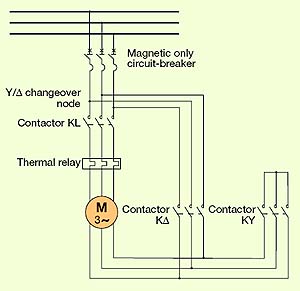
Magnetic only circuit-breaker - Автоматический выключатель с электромагнитным расцепителем
Y/Δ changeover node - Узел переключения со звезды на треугольник
Contactor KL - Контактор KL
Thermal relay - Тепловое реле
Contactor KΔ - Контактор KΔ
Contactor KY- Контактор KY
Параллельные тексты EN-RU Star-delta Y/Δ starting
Star-delta starting is the best known system and perhaps the commonest starting system at reduced voltage; it is used to start the motor reducing the mechanical stresses and limiting the current values during starting; on the other hand, it makes available a reduced inrush torque.This system can be used for motors with terminal box with 6 terminals and double supply voltage.
It is particularly suitable for no-load starting or with low and constant load torque or lightly increasing load torque, such as in the case of fans or low power centrifugal pumps.
Making reference to the diagram of Figure 6, the starting modality foresees the initial phase with star-connection of the windings to be realized through the closing of the circuit-breaker, of the line contactor KL and of the star contactor KY.
After a suitable predetermined period of time, the opening of the contactor KY and the closing of KΔ allow switching to delta-connection, which is also the configuration of normal running position.
[ABB]Пуск переключением со звезды на треугольник
Пуск переключением со звезды на треугольник является самым известным способом и, возможно, самой распространенной схемой пуска на пониженном напряжении. С одной стороны, этот способ используется для снижения механических нагрузок и ограничения пускового тока, а с другой - обеспечивает уменьшение пускового момента.Такая возможность может быть реализована в двигателях с шестью зажимами в выводной коробке, что позволяет питать его от двух напряжений.
Особенно этот способ подходит для ненагруженного пуска и пуска с низким постоянным или немного увеличивающимся вращающим моментом, например, для пуска вентиляторов или маломощных центробежных насосов.
Схема пуска переключением со звезды на треугольник представлена на рисунке 6. В начальный момент пуска обмотки статора соединяют звездой путем замыкания контактов автоматического выключателя, линейного контактора KL и контактора KY со схемой "звезда".
По истечении заданного времени контакты контактора KY размыкаются и замыкаются контакты контактора КΔ со схемой треугольник.
В результате выполняется переключение обмоток статора со схемы «звезда» на схему «треугольник».
Обе схемы соединения обмоток являются схемами нормального рабочего режима.
[Перевод Интент]Тематики
Обобщающие термины
EN
- star-delta starting
- Y/Δ starting
DE
FR
Русско-английский словарь нормативно-технической терминологии > пуск переключением со звезды на треугольник
См. также в других словарях:
Initial D Arcade Stage — Infobox VG title = Initial D Arcade Stage caption = PlayStation 2 port deletable image caption|1=Sunday, 20 January 2008 developer = Sega Rosso publisher = Sega released = genre = Arcade style racing modes = Single player, online multiplayer… … Wikipedia
Mode d'opération (cryptographie) — En cryptographie, un mode d opération est la manière de traiter les blocs de texte clairs et chiffrés au sein d un algorithme de chiffrement par bloc. Historiquement, les modes d opération ont été abondamment étudiés pour leur propriétés de… … Wikipédia en Français
mode — mode1 /mohd/, n. 1. a manner of acting or doing; method; way: modern modes of transportation. 2. a particular type or form of something: Heat is a mode of motion. 3. a designated condition or status, as for performing a task or responding to a… … Universalium
Initial D Arcade Stage 4 — Infobox VG title = Initial D Arcade Stage 4 developer = Sega Rosso publisher = Sega released = flagicon|Japan February 21 2007 flagicon|Hong Kong June 2007 flagicon|Australia July 2007 flagicon|United States November 2007 genre = Racing modes =… … Wikipedia
Counter-Strike: Condition Zero — Developer(s) Valve Corporation Gearbox Software Ritual Entertainment Turtle Rock Studios … Wikipedia
Courant–Friedrichs–Lewy condition — In mathematics, the Courant–Friedrichs–Lewy condition (CFL condition) is a necessary condition for convergence while solving certain partial differential equations (usually hyperbolic PDEs) numerically by the method of finite differences.[1] It… … Wikipedia
Normal mode — For other types of mode, see Mode (disambiguation). Vibration of a single normal mode of a circular disc with a pinned boundary condition along the entire outer edge. See other modes. A normal mode of an oscillating system is a pattern of motio … Wikipedia
Steady-state condition — In telecommunication, the term steady state condition has the following meanings: *In a communications circuit, a condition in which some specified characteristic of a condition, such as a value, rate, periodicity, or amplitude, exhibits only… … Wikipedia
исходное положение — Режим работы аналоговой или аналого цифровой вычислительной системы, машины, устройства или их составных частей, характеризующийся исходным состоянием машинных переменных. [ГОСТ 18421 93] Тематики аналоговая и аналого цифровая выч.техн. EN… … Справочник технического переводчика
mechanics — /meuh kan iks/, n. 1. (used with a sing. v.) the branch of physics that deals with the action of forces on bodies and with motion, comprised of kinetics, statics, and kinematics. 2. (used with a sing. v.) the theoretical and practical application … Universalium
Partial differential equation — A visualisation of a solution to the heat equation on a two dimensional plane In mathematics, partial differential equations (PDE) are a type of differential equation, i.e., a relation involving an unknown function (or functions) of several… … Wikipedia
